Does Teeth Whitening Damage Your Enamel?
Dr. Sushma Patne on 24 August, 2026
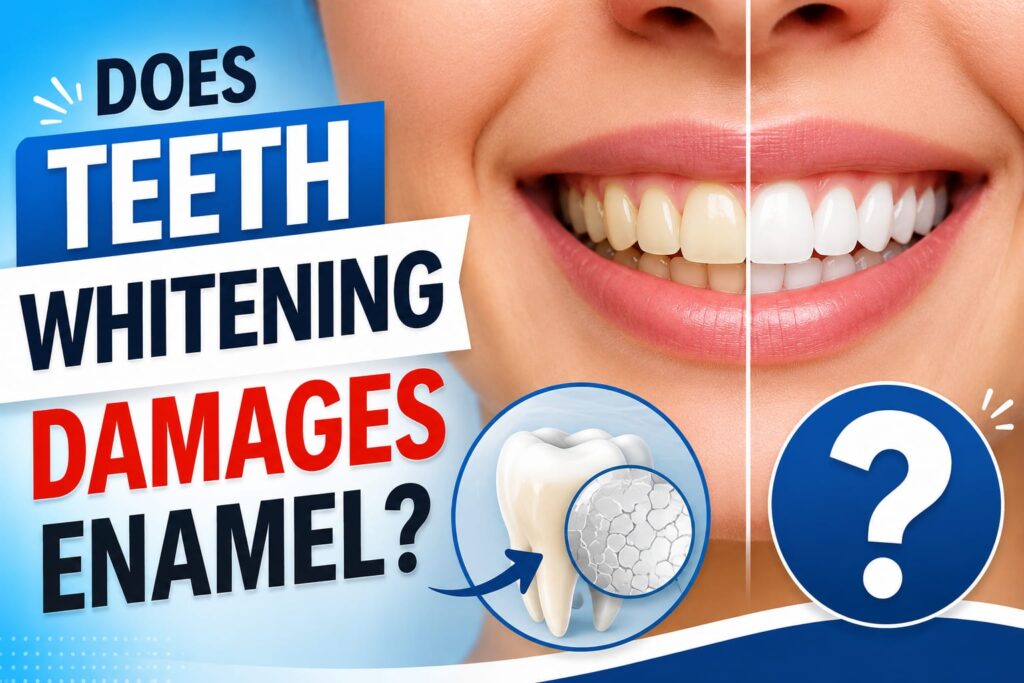
A bright, white smile is one of the most sought-after cosmetic goals in dentistry today. However, a common concern that prevents many people from pursuing teeth whitening is the fear of damaging their tooth enamel. If you have been asking yourself “does teeth whitening damage your enamel?” or wondering whether “teeth whitening is safe on tooth enamel,” this comprehensive guide provides the evidence-based answers you need.
This article explores how whitening agents work, what scientific research reveals about their effects on enamel, and how you can achieve a radiant smile safely under professional supervision.
Understanding Tooth Enamel: The Protective Shield
Tooth enamel is the hard, mineralised outer layer that protects your teeth from decay, sensitivity, and daily wear. It shields the inner layers of your teeth from acids, bacteria, and temperature changes. Although enamel is the strongest material in the human body, it has one critical limitation: once it is lost, it cannot be regenerated .
This is why protecting your enamel is so important for long-term dental health. Understanding how whitening treatments interact with enamel is essential before undergoing any cosmetic procedure.
How Teeth Whitening Actually Works
Most professional teeth whitening treatments use peroxide-based agents such as hydrogen peroxide or carbamide peroxide . These chemicals penetrate the enamel and break down the complex molecules that cause stains from food, drinks, smoking, and ageing .
It is important to understand that whitening does not remove enamel; it only lightens the colour of stains trapped inside the enamel structure . When used properly and under professional supervision, whitening products are designed to be effective without causing permanent harm.
What Scientific Research Reveals About Enamel Safety
Recent clinical studies have provided valuable insights into the relationship between teeth whitening and enamel health. A prospective study published in 2025 evaluated the effects of three commonly used whitening methods on enamel microhardness .
Key Findings from the Study
The research involved 90 participants divided into three groups:
In-Office Bleaching: Professional treatment using 35% hydrogen peroxide activated by a light source
At-Home Bleaching: Use of 10% carbamide peroxide gel in custom trays for 14 consecutive days
Over-the-Counter (OTC) Whitening: Commercial whitening products with lower active ingredient concentrations
Results on Enamel Microhardness
The study found that significant reductions in enamel microhardness occurred in all groups after treatment:
| Whitening Method | Average Reduction in Enamel Microhardness |
|---|---|
| In-Office Bleaching | 18% reduction |
| At-Home Bleaching | 12% reduction |
| OTC Whitening | 6% reduction |
The in-office bleaching group showed the greatest reduction in enamel hardness, which can be attributed to the high concentration of hydrogen peroxide (35%) and the use of light or laser activation that accelerates the oxidative reaction but also increases enamel demineralisation .
The Trade-Off: Efficacy vs. Enamel Protection
While in-office bleaching caused the most significant reduction in enamel hardness, it was also associated with the highest patient satisfaction, with an immediate satisfaction score of 4.8 out of 5 . OTC products, which caused the least enamel damage (6% reduction), had the lowest satisfaction score at 3.5 out of 5 .
This highlights the clinical dilemma: higher concentrations deliver faster, more dramatic results but carry a greater risk of temporary enamel demineralisation. At-home bleaching with custom trays offers a moderate compromise, while OTC products are the safest but least effective option .
Are the Enamel Changes Permanent?
This is perhaps the most important question for anyone considering teeth whitening.
Temporary Changes
Most enamel changes from teeth whitening are temporary and reversible. Research indicates that controlled application of hydrogen peroxide and carbamide peroxide preserves enamel integrity when evidence-based clinical protocols are followed .
The study noted that although immediate microhardness reduction occurred, there was a partial recovery at the three-month follow-up, suggesting that natural salivary remineralisation helps reverse some of the effects . Temporary alterations in enamel mineral balance and surface characteristics are generally reversible through natural salivary remineralisation or adjunctive remineralising therapies .
Permanent Damage
However, permanent damage is possible with overuse, misuse, or unsupervised application of whitening products . Products bought online, DIY remedies using lemon juice, baking soda, or charcoal, and undiluted hydrogen peroxide are particularly risky because they can be highly abrasive or acidic and wear down enamel, leading to increased decay, sensitivity, and gum issues .
Excessive or chronic bleaching can cause visible enamel surface changes including pitting, rough enamel texture, chalky appearance, or uneven staining . In extreme cases, overuse can create actual enamel loss (erosion) that is irreversible .
Why Tooth Sensitivity Occurs
Tooth sensitivity is the most common side effect of teeth whitening, affecting up to 45-72% of patients receiving professional bleaching .
The Mechanism
Sensitivity occurs when whitening agents penetrate through the enamel to the underlying dentin, causing irritation of the odontoblast cells and fluid flow changes within the dentin tubules. Hydrogen peroxide oxidatively damages proteins in the dentin tubule, irritating the nerves within the tubules and creating pain signals .
How Long Does Sensitivity Last?
The sensitivity typically peaks within 24-48 hours after bleaching and resolves within days to weeks as the dentin recovers . However, repeated bleaching sessions can create repeated sensitivity episodes that may become more pronounced with successive treatments .
Professional Whitening vs. At-Home and DIY Methods
The safety of teeth whitening depends largely on the method chosen and the supervision provided.
Professional In-Office Whitening
Getting your teeth whitened by a dentist or under their supervision is the safest choice . Before starting, the dentist will check for cavities, gum disease, enamel wear, and any dental work such as crowns or fillings to ensure whitening is appropriate for you .
Professional supervision ensures:
- Correct concentration selection for your specific needs
- Proper application with protective barriers for gums
- Management of pre-existing dental conditions
- Post-treatment preventive care
At-Home Whitening with Dentist Supervision
Some patients can safely use custom-fitted trays with professional-grade gel provided by their dentist. This method offers a balanced approach with moderate enamel impact (12% reduction) and good results.
Over-the-Counter Products
While convenient and widely available, OTC whitening products carry risks. Without a dentist’s guidance, you are more likely to experience gum irritation, uneven whitening, or sensitivity due to improper use . Dentists warn against patronising non-dental establishments such as spas, salons, or beauty parlours for teeth whitening, as these providers often use unsafe products and lack the necessary training to perform dental procedures safely .
Who Should Avoid Teeth Whitening?
Teeth whitening is not suitable for everyone :
| Group | Reason |
|---|---|
| Children under 16 | Proportionally larger pulp chambers sit closer to enamel; peroxide reaches living tissue faster |
| Pregnant or breastfeeding women | No long-term human safety data on peroxide during pregnancy; defer until after weaning |
| Untreated cavities | Peroxide enters carious lesions directly and reaches the pulp, causing acute pain |
| Active gum disease | Receded, inflamed gums expose root dentin lacking enamel barrier |
| Exposed root surfaces | Cementum is thinner and more permeable than enamel |
| Peroxide allergy | Rare but real reaction ranging from hives to anaphylaxis |
| Tetracycline staining | Intrinsic dentin staining responds poorly to bleaching |
Safety Tips for Protecting Your Enamel
If you are considering teeth whitening, follow these evidence-based guidelines to protect your enamel:
Always consult a dentist first. A thorough examination ensures you are a suitable candidate and identifies any underlying issues that must be addressed before whitening .
Pre-treat with desensitising toothpaste. Using potassium nitrate toothpaste for two weeks before whitening raises the nerve firing threshold and reduces intra-session sensitivity .
Use the shortest effective exposure. Do not exceed recommended times, as efficacy does not rise linearly with longer contact .
Space out sessions. Leaving a day between sessions allows saliva to remineralise enamel and lowers cumulative oxidative load on the pulp .
Avoid abrasive DIY methods. Never use household bleach, lemon juice, baking soda, or charcoal for whitening .
Remineralise with nano-hydroxyapatite toothpaste. This occludes dentinal tubules and integrates into enamel, easing post-session sensitivity faster than fluoride alone .
The Role of Professional Guidance
For patients in Mumbai, Toothfirst Dental Care offers professional teeth whitening services under the supervision of Dr. Sushma Patne. With over 21 years of clinical experience, Dr. Sushma provides:
- Comprehensive pre-whitening examination to assess enamel health
- Customised treatment plans balancing efficacy and enamel preservation
- Professional application with protective barriers
- Post-treatment care and follow-up
- Safe, effective whitening using clinically validated products
Is Teeth Whitening Safe on Tooth Enamel?
The answer depends on how whitening is performed.
Teeth whitening does not permanently damage enamel when done correctly under professional supervision. The temporary reduction in enamel microhardness is reversible through natural salivary remineralisation .
However, permanent damage can occur with overuse, misuse, unsupervised application, or use of unregulated products. The key to safe whitening is choosing a qualified dental professional who can assess your suitability, select appropriate concentrations, and provide proper application and aftercare.
Book Your Professional Teeth Whitening Consultation
Ready to achieve a brighter smile safely? Contact Toothfirst Dental Care today for a comprehensive consultation.
Call or WhatsApp: +91 99309 09043
Email: drsushma@toothfirstlife.com
Clinic Address:
Parvati CHS Shop No. 5, Om Shanti Circle, Near Club Aquaria, Devidas Lane, Borivali West, Mumbai – 400091